Trophic Interactions: Fishing in Balance (FiB)
http://tutor-web.net/fish/fish610.2/Lecture30/slide1.jpg\begin{itemize}
\item What is FiB
\item How FiB is calculated
\item What the results indicate
\item Pros/cons of the indicator
\end{itemize}
\item What is FiB
\item How FiB is calculated
\item What the results indicate
\item Pros/cons of the indicator
\end{itemize}
Details
\subsubsection*{What is FiB and How is it Calculated}
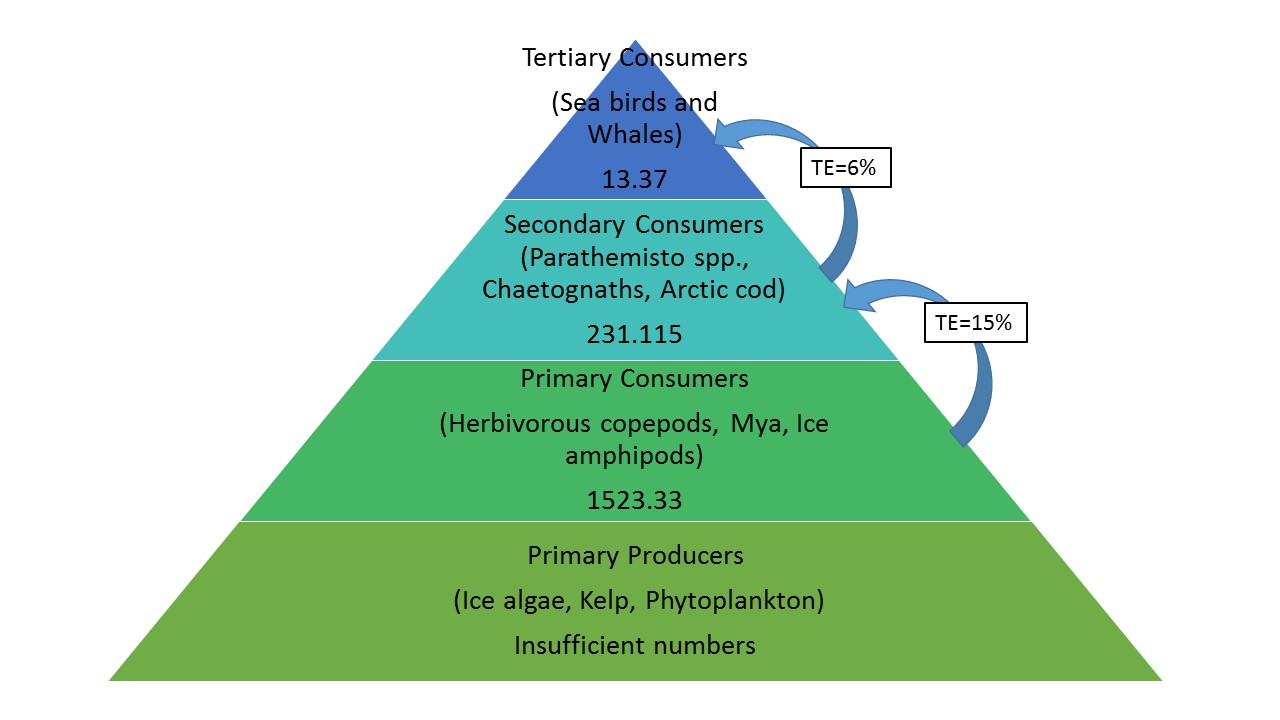
The fishing in balance index (FiB) addresses community dynamics by applying the law of 10\%. The law of 10\% states that on average only 10\% of the energy available at one trophic level will be passed onto the next trophic level. The 90\% energy loss is attributed to maintenance, reproduction, and other activities by the animals in the system.
FiB aims to capture the effect of intentionally fishing down, i.e. fishing a lower trophic level, has on the fisheries production. It is assumed that any decrease in mean trophic level should be matched by an ecologically appropriate increase in the same trophic level, i.e. the increase in catches should be proportional to the transfer efficiency, or how well energy moves, between trophic levels. To calculate FiB the following equation in used:
$$FiB_K=log[Y_K \times (1/TE)^{MTI_K}]-log[Y_0(1/TE)^{MTL_0}]$$
where $K$ is the year, $Y_K$ are the landings in year $K$, $TE$ is the transfer efficiency (which is usually set to 0.1 to reflect the law of 10\%), $MTI_K$ is the mean trophic index in year $K$, and $MTL_0$ is the mean trophic level of landings in year 0 (year 0 can be any year used as a baseline).
\subsubsection*{Interpreting FiB Results}
The number derived from the FiB index indicates whether the increase in landings from fishing a lower trophic level is proportional to the expected increase given the transfer efficiency between trophic levels. Thus, like the MTI, one is concerned with the trend across time rather than the value itself. A stable FiB indicates that a proportional shift is occurring while a decrease may be indicative of an impaired fishery or unreported discards.
\subsubsection*{Pros/Cons of FiB}
In order for FiB to function properly, it must be assumed that the transfer efficiency between trophic levels is constant across trophic levels. Similarly, the transfer efficiency must be known. Given the assumptions, FiB is believed to be a better indicator of ecosystem change than catch or catch composition as a result of its integrative nature.
The fishing in balance index (FiB) addresses community dynamics by applying the law of 10\%. The law of 10\% states that on average only 10\% of the energy available at one trophic level will be passed onto the next trophic level. The 90\% energy loss is attributed to maintenance, reproduction, and other activities by the animals in the system.
FiB aims to capture the effect of intentionally fishing down, i.e. fishing a lower trophic level, has on the fisheries production. It is assumed that any decrease in mean trophic level should be matched by an ecologically appropriate increase in the same trophic level, i.e. the increase in catches should be proportional to the transfer efficiency, or how well energy moves, between trophic levels. To calculate FiB the following equation in used:
$$FiB_K=log[Y_K \times (1/TE)^{MTI_K}]-log[Y_0(1/TE)^{MTL_0}]$$
where $K$ is the year, $Y_K$ are the landings in year $K$, $TE$ is the transfer efficiency (which is usually set to 0.1 to reflect the law of 10\%), $MTI_K$ is the mean trophic index in year $K$, and $MTL_0$ is the mean trophic level of landings in year 0 (year 0 can be any year used as a baseline).
\subsubsection*{Interpreting FiB Results}
The number derived from the FiB index indicates whether the increase in landings from fishing a lower trophic level is proportional to the expected increase given the transfer efficiency between trophic levels. Thus, like the MTI, one is concerned with the trend across time rather than the value itself. A stable FiB indicates that a proportional shift is occurring while a decrease may be indicative of an impaired fishery or unreported discards.
\subsubsection*{Pros/Cons of FiB}
In order for FiB to function properly, it must be assumed that the transfer efficiency between trophic levels is constant across trophic levels. Similarly, the transfer efficiency must be known. Given the assumptions, FiB is believed to be a better indicator of ecosystem change than catch or catch composition as a result of its integrative nature.