Stakeholder Involvement
http://tutor-web.net/fish/fish610.3/Lecture20/slide1-1.jpg\begin{itemize}
\item Definition of stakeholders
\item Examples of stakeholders
\item Role of stakeholders
\end{itemize}
\item Definition of stakeholders
\item Examples of stakeholders
\item Role of stakeholders
\end{itemize}
Details
\subsection*{Definition and Example of Stakeholders}
\begin{defn}[Stakeholder]
An individual, group, or organization with a vested interest in management decisions and are directly impacted by them (either positively or negatively).
\end{defn}
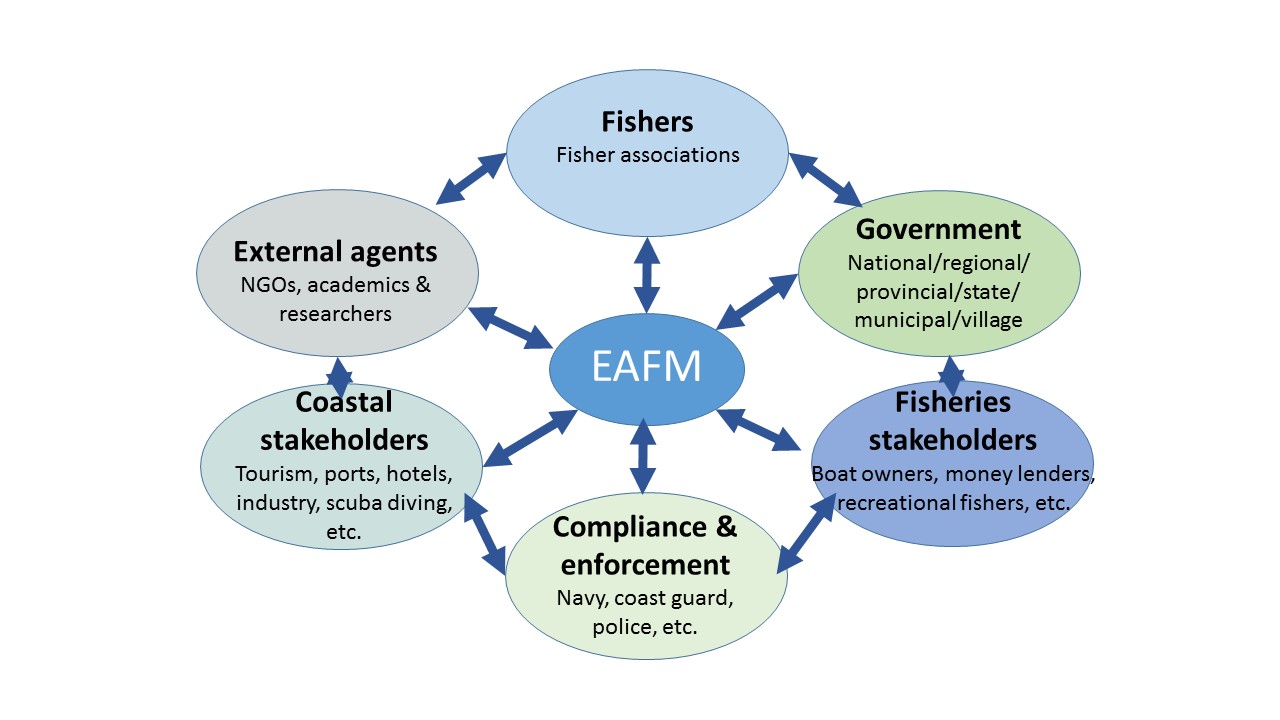
Within an EAFM framework stakeholders can include fishermen, fishing communities, animal protection groups, among others. Thus, a diversity of interests and backgrounds are represented by the stakeholder groups. This diversity is critically important to accomplishing a true ecosystem approach.
\subsection*{Role of Stakeholders}
Stakeholders play a critical role in all aspects of fisheries management within an EAFM framework. Infact, the inclusion of stakeholders is a defining characteristics of any EAFM plan. As a result, it is critically important that stakeholders be included in as many aspects of EAFM planning, execution, and evaluation as possible.
During the planning process a stakeholder workshop should be conducted in which all relevant stakeholders are present. The stakeholders present should represent different sectors of the community and management agencies, for more information on determining who should be involved in stakeholder workshops see \cite{staples}. The purpose of the stakeholder workshop is to:
\begin{itemize}
\item initiate and stimulate an EAFM dialog
\item organize involvement
\item help stakeholders understand EAFM
\item identify problems, concerns, and opportunities
\item provide input
\item identify other necessary stakeholders
\item initiate education campaigns
\end{itemize}
Subsequent stakeholder workshops are used to:
\begin{itemize}
\item select the FMU
\item identify broad management goals
\item obtain necessary background information
\item obtain information to reduce uncertainty in the management models
\end{itemize}
Once management decisions have been put into action continuous re-evaluation of the management actions success is needed. During the management evaluation process, stakeholders are used to gain "field" data and provide insight into the practical impacts, i.e. are fishermen seeing/catching fewer fish, are fish prices rising, have ecological processes been altered, etc.
Thus, stakeholders play two major roles, 1) help fill knowledge gaps to reduce model uncertainty (i.e. resolve stock size discrepancies, explain unaccounted mortality, etc.) and 2) increase the legitimacy of the legislative process (i.e. increase transparency, make joint policy recommendations, etc.).
\begin{defn}[Stakeholder]
An individual, group, or organization with a vested interest in management decisions and are directly impacted by them (either positively or negatively).
\end{defn}
Within an EAFM framework stakeholders can include fishermen, fishing communities, animal protection groups, among others. Thus, a diversity of interests and backgrounds are represented by the stakeholder groups. This diversity is critically important to accomplishing a true ecosystem approach.
\subsection*{Role of Stakeholders}
Stakeholders play a critical role in all aspects of fisheries management within an EAFM framework. Infact, the inclusion of stakeholders is a defining characteristics of any EAFM plan. As a result, it is critically important that stakeholders be included in as many aspects of EAFM planning, execution, and evaluation as possible.
During the planning process a stakeholder workshop should be conducted in which all relevant stakeholders are present. The stakeholders present should represent different sectors of the community and management agencies, for more information on determining who should be involved in stakeholder workshops see \cite{staples}. The purpose of the stakeholder workshop is to:
\begin{itemize}
\item initiate and stimulate an EAFM dialog
\item organize involvement
\item help stakeholders understand EAFM
\item identify problems, concerns, and opportunities
\item provide input
\item identify other necessary stakeholders
\item initiate education campaigns
\end{itemize}
Subsequent stakeholder workshops are used to:
\begin{itemize}
\item select the FMU
\item identify broad management goals
\item obtain necessary background information
\item obtain information to reduce uncertainty in the management models
\end{itemize}
Once management decisions have been put into action continuous re-evaluation of the management actions success is needed. During the management evaluation process, stakeholders are used to gain "field" data and provide insight into the practical impacts, i.e. are fishermen seeing/catching fewer fish, are fish prices rising, have ecological processes been altered, etc.
Thus, stakeholders play two major roles, 1) help fill knowledge gaps to reduce model uncertainty (i.e. resolve stock size discrepancies, explain unaccounted mortality, etc.) and 2) increase the legitimacy of the legislative process (i.e. increase transparency, make joint policy recommendations, etc.).